U-M to improve pedestrian, vehicle safety at intersections with $5.66 million from U.S. DOT
New system could provide warnings to pedestrians and drivers to prevent crashes.
1–2 minutes

New system could provide warnings to pedestrians and drivers to prevent crashes.
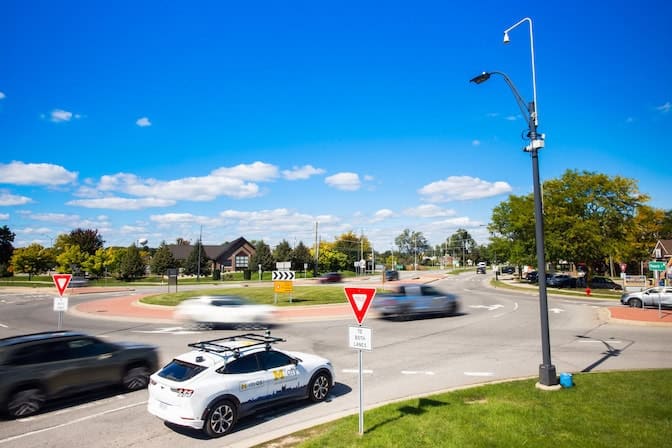
Intersections account for a quarter of U.S. traffic deaths and half of traffic injuries. With $5.66 million from the U.S. Department of Transportation, the University of Michigan Transportation Research Institute (UMTRI) is developing a crash-prevention system to change that. SAFETI (Safety Actions for Everyone at Traffic Intersections) builds on MSight, UMTRI’s open-source roadside perception framework that detects vehicles, pedestrians, and cyclists. SAFETI predicts conflicts before they happen and responds in real time. It can send warnings to drivers’ dashboards and pedestrians’ phones, light up in-pavement lights, or adjust traffic signals, such as holding cross traffic at red when a driver is about to run a light. The system identifies only object types, not individual vehicles or people. “Our goal is to prevent crashes in the moment and to make intersections safer over time,” said UMTRI Director Henry Liu, the project’s principal investigator.
The project will run about three and a half years in two phases. First, the team will build and test prototypes at Mcity’s physical and virtual test environments, with robots standing in for pedestrians and cyclists. Then they’ll deploy the system at four Ann Arbor intersections. UMTRI research engineer Sean Shen leads the MSight work, and Monica Jones, head of UMTRI’s Human Factors Group, leads the human-factors evaluation. Partners include General Motors, Ford, Volkswagen, Ouster, the Michigan Department of Transportation, the City of Ann Arbor, and SEMCOG. The technology will eventually be released as open source, enabling communities nationwide to adopt it.
Michigan Engineering’s Jim Lynch has written in-depth on this story on the Michigan Engineering News website.