UMTRI and GM: Using Real-World Evidence to Advance a “Zero Crashes” Vision
A “zero crashes” future depends on more than new safety technology—it requires credible, real-world evidence that those systems prevent crashes and reduce injuries across the driving conditions people face every day. That’s the shared focus of a long-running collaboration between the University of Michigan Transportation Research Institute (UMTRI) and General Motors (GM): pair large-scale safety deployment with rigorous field evaluation to accelerate progress toward zero crashes.
A Collaboration Designed for Real-World Learning at Scale
The latest UMTRI–GM effort is the eighth in a series of Advanced Driver Assistance Systems (ADAS) field effectiveness studies. The ADAS features examined include those designed to address crashes that are associated with the overwhelming majority of fatalities and serious injuries, which include roadway departures, rear-end striking, intersection, pedestrian, bicyclist, and lane change crashes. In this latest study, GM provided UMTRI a list of the ADAS content included in approximately 12 million GM Model Year 2020–2024 vehicles. UMTRI then matched these records to over 700,000 police-reported crashes across 18 states.
Turning Technology Deployment into Measured Safety Outcomes
UMTRI independently estimated ADAS feature effectiveness using a quasi-induced exposure logistic regression approach. In this analysis, the system-relevant crash type is expected to be less frequent in feature-equipped vehicles, and the system-irrelevant crash type (e.g., being struck in the rear) is used to control for travel (crash) exposure between ADAS-equipped versus unequipped vehicles. This analysis accounted for differences in the crash-involved vehicles (model year, model, and vehicle type) and a wide range of police-reported variables (crash year, driver age, driver gender, posted speed limit, light condition, road surface condition, weather, and the presence of alcohol, drugs, distracted driver, and fatigued driver).
Big Gains in Reducing Crash Injuries
The large-scale nature of this effort allowed focusing on crashes including injuries, which are assessed by police at the crash scene using the “KABCO” scale. Under this scale, K = fatal injury, A = suspected serious injury, B = suspected minor injury, C = possible injury, and O = no apparent injury (i.e., property damage only). For the analysis of rear-end and lane-departure crash types, injury crashes were defined as those with “K”, “A”, or “B” injury levels, collectively referred to as “KAB” crashes. For front pedestrian and bicyclist crashes, a broader “KABC” injury criterion was used, since such crashes are rare from a statistical perspective.
The results are clear: vehicles equipped with ADAS features are significantly less likely to be involved in crashes that result in injuries.
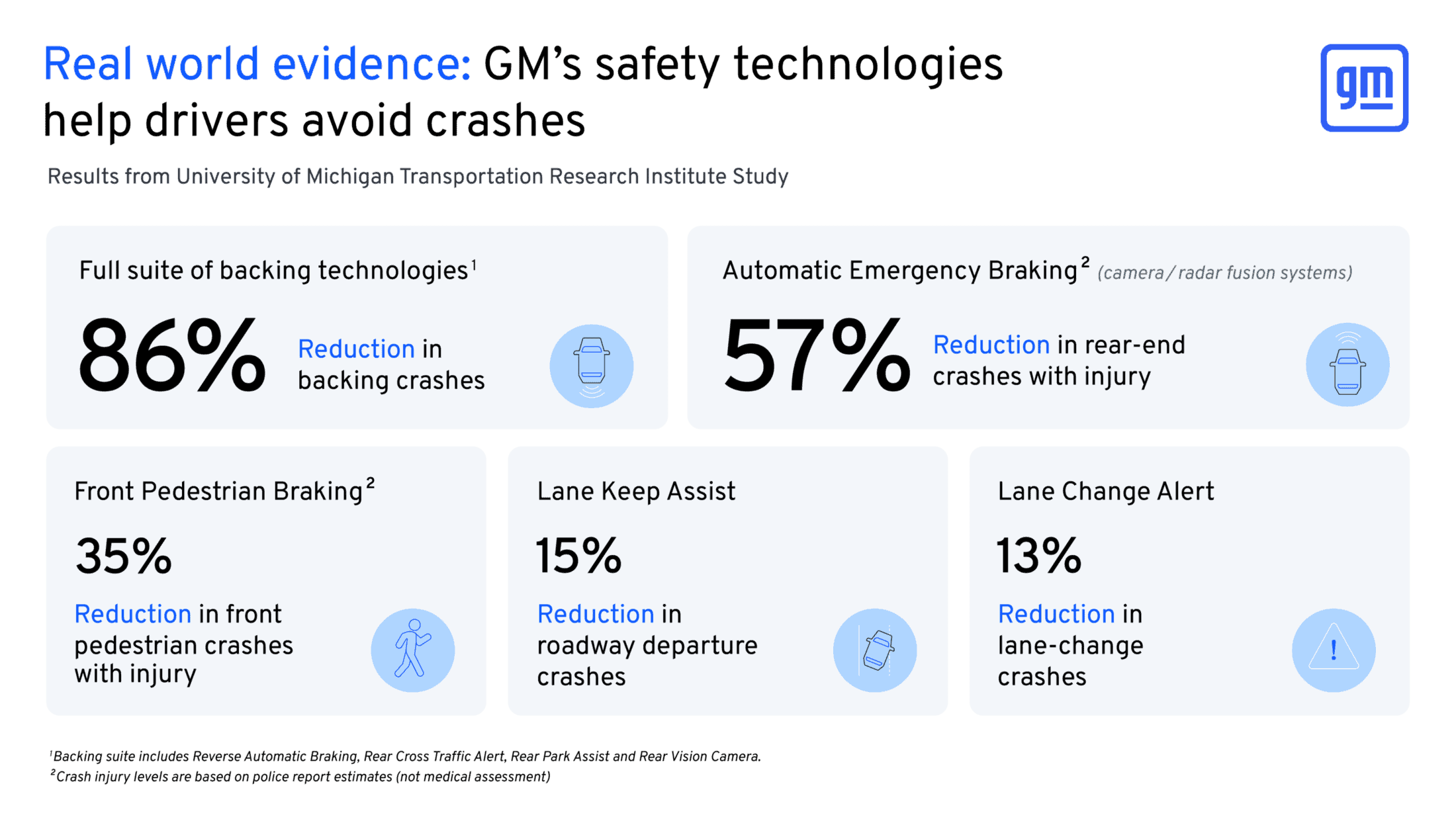
- Rear-end striking injury crashes were reduced by 57% by Automatic Emergency Braking
- Front Pedestrian injury crashes were reduced by 35% by Front Pedestrian Braking
- Single-vehicle roadway departure injury crashes were reduced by 14% by Lane Keep Assist
In addition, crash prevention benefits were observed for common crash types that are less likely to involve injuries:
- Backing crashes were reduced by 86% for vehicles equipped with a suite of backing ADAS features including Reverse Automatic Braking, Rear Cross Traffic Alert, Rear Park Assist, and Rear Vision Camera
- Lane change crashes were reduced by 13% by Lane Change Alert
Working Together Toward Zero Crashes
Across all crash types examined, the study reinforces a powerful conclusion:
ADAS technologies are already delivering meaningful injury reduction and crash prevention benefits today—and their impact will only grow as the fleet penetration of ADAS features grows and feature improvements occur.
By combining GM’s broad deployment of safety technologies with UMTRI’s independent field evaluation, the partnership creates a practical learning system—deploy, measure, learn, improve—that supports measurable progress toward zero crashes. A defining strength of the UMTRI–GM partnership is its iterative nature: each study cycle builds evidence that can guide feature refinement, prioritize crash types with the greatest remaining injury burden, and strengthen evaluation methods as new data sources become available.
More broadly, UMTRI emphasizes that progress toward a zero crashes vision should follow a holistic Safe System Approach that extends beyond vehicle technology alone. Broader system-wide strategies are also essential for addressing unsafe driver and road user behaviors (unbelted, speeding, and impairment from alcohol, drugs, drowsiness, or distraction) and implementing roadway infrastructure improvements that target high-harm crash types.
Additional details on this research are published on GM News
The full report is found in the U-M Library DeepBlue