Artificial intelligence is transforming transportation, from traffic management and roadway safety to infrastructure maintenance and freight operations. But as AI technologies advance, public agencies face increasingly complex questions: Which tools work? How can they be deployed responsibly? And how can agencies distinguish proven solutions from promising sales pitches?
Three of the nation’s leading transportation research institutes are joining forces to help answer those questions.
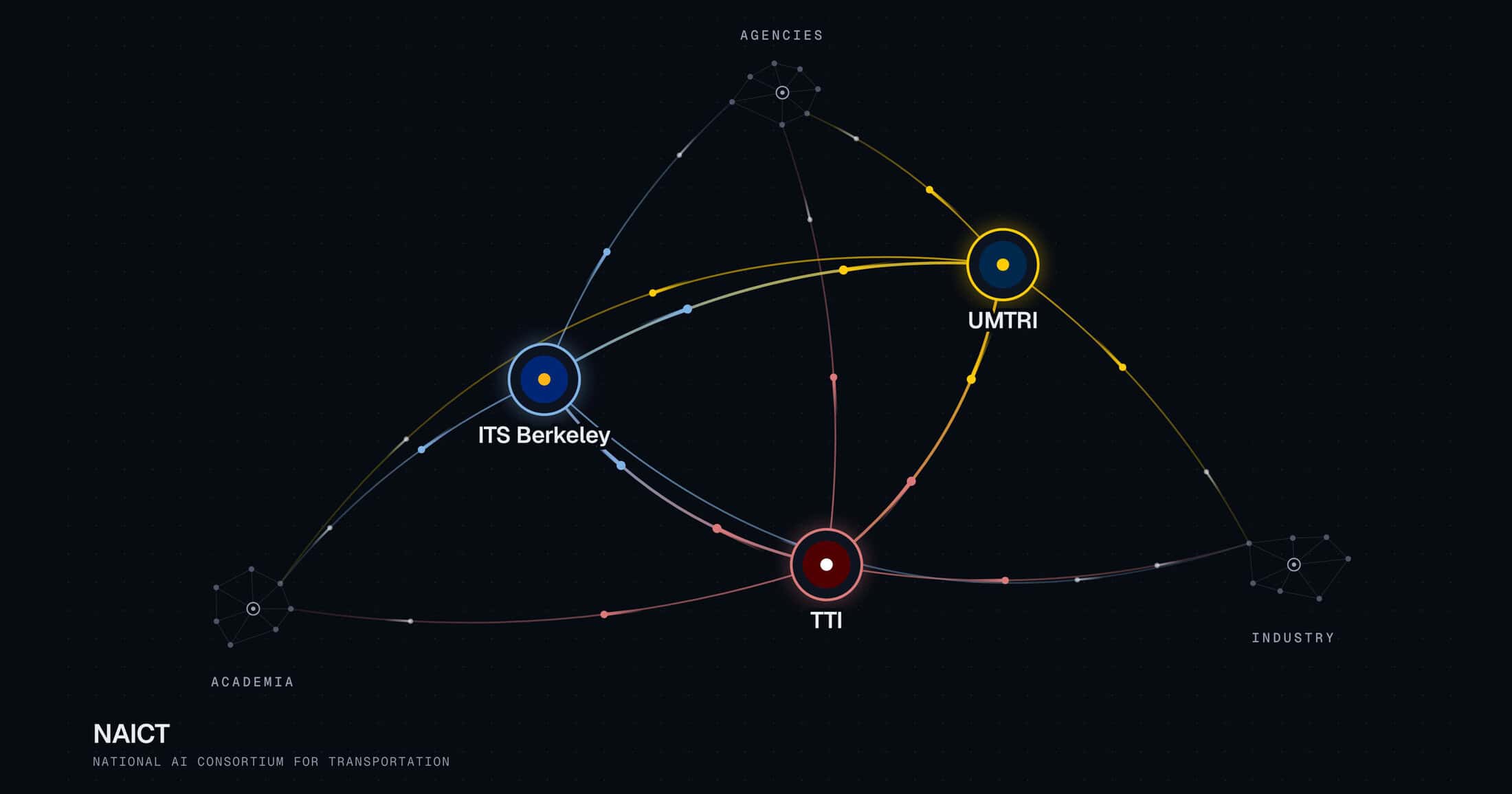
The National AI Consortium for Transportation (NAICT) brings together the University of Michigan Transportation Research Institute (UMTRI), UC Berkeley Institute of Transportation Studies (ITS Berkeley) and the Texas A&M Transportation Institute (TTI) to provide a trusted, non-commercial resource for evaluating, deploying and governing AI in transportation.
“NAICT is designed to give agencies and industry a single, credible, non-commercial resource for evaluating, deploying and governing AI in real-world transportation operations,” said UMTRI Director Henry Liu. “We need to have a guided discussion to help shape what AI is and what it can do in safe, responsible and effective ways.”
Liu co-leads the consortium with Scott Moura, director of Partners for Advanced Transportation Technology, an ITS Berkeley research center , and Greg Winfree, director of TTI.
Building with agencies, not just for them
Rather than developing solutions in isolation, NAICT is inviting state and local transportation agencies, industry partners, professional organizations and researchers to help shape its priorities.
Through education, governance and standards, and applied research, the consortium aims to help agencies make informed decisions about AI technologies and move promising applications into real-world practice.
Opportunities to engage are already underway, with a series of workshops and events planned through early 2027:
- November 5, 2026 | UC Berkeley Listening Session: NAICT’s first workshop and listening session, held during PATH’s 40th anniversary symposium, will invite transportation leaders and practitioners to share their AI challenges and identify the support they need.
- January 2027 | Transportation Research Board Annual Meeting: NAICT will host a panel and interactive workshop in Washington, D.C., bringing together experts in research, industry and policy to explore safe AI deployment, shared resources, workforce development and emerging policy challenges.
- Early 2027 | Education and Governance Resources: NAICT plans to introduce its first educational offerings and a draft AI governance framework, with opportunities for agencies and partners to provide input before broader release.
Shaping the future of AI in transportation
As transportation agencies face growing pressure to adopt emerging technologies, NAICT aims to provide the independent expertise, shared knowledge and practical guidance needed to make informed decisions.
And the consortium wants to hear directly from those responsible for putting AI to work.
“We’re moving fast, and we’d rather build this with agencies than for them,” said Liu. “If you’re responsible for putting AI to work on public roads, we want you in the room. Come find us at TRB.”
Interested in helping shape the future of AI in transportation?
Visit https://www.naict.org for more information