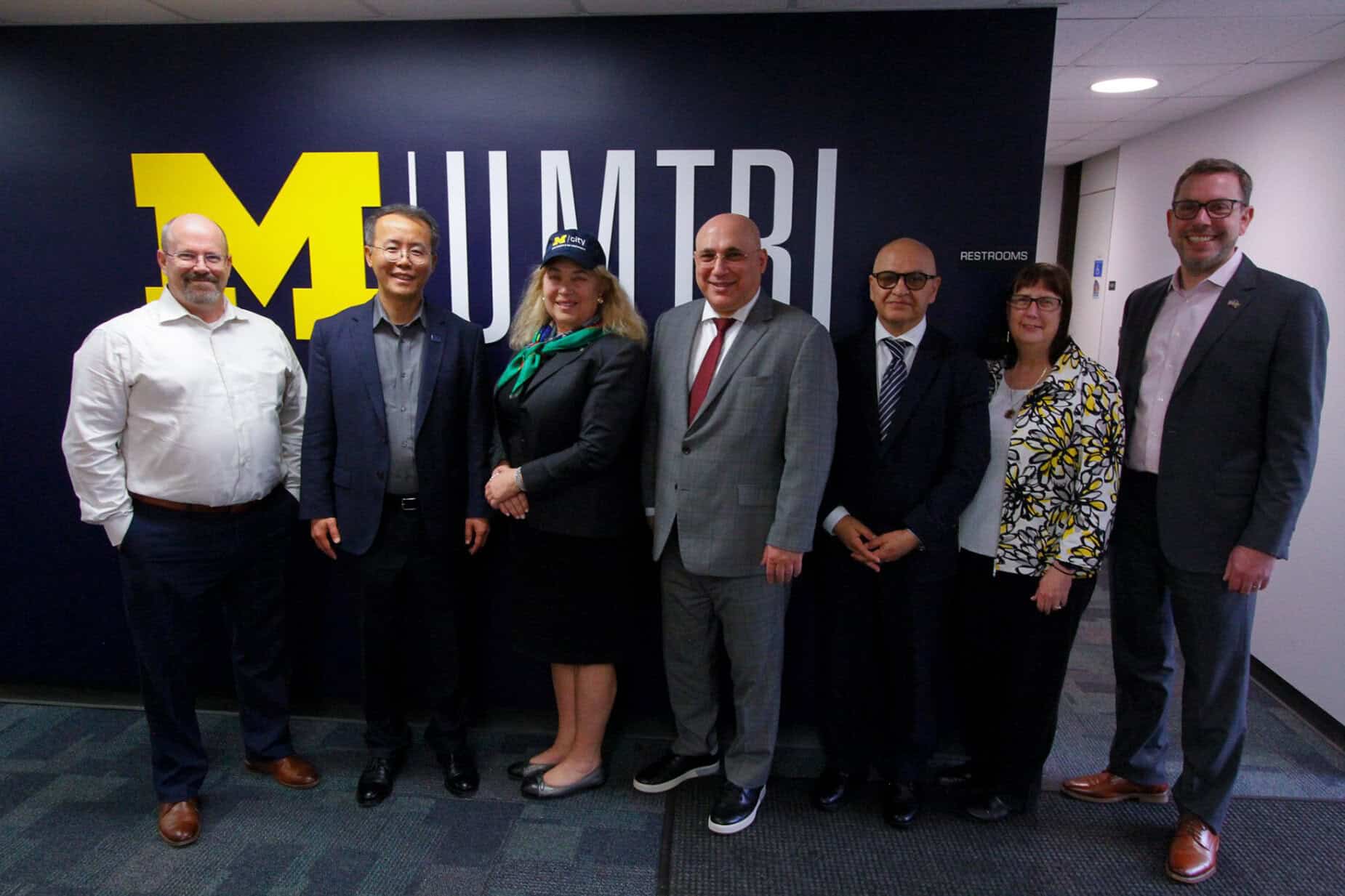
Earlier this spring, the University of Michigan Transportation Research Institute (UMTRI) and Mcity welcomed federal transportation leaders for an in-depth look at the research, technologies, and partnerships shaping the future of transportation.
The visit included Assistant Secretary for Research and Technology, Seval Oz; Principal Deputy Assistant Secretary, Michael Halem; Director of Research, Development and Technology, Firas Ibrahim; and Acting Director of the University Transportation Centers Grants Program, Hamid Ghasemi. The federal transportation leaders spent the day engaging with researchers, touring facilities, and experiencing firsthand how University of Michigan innovations are advancing transportation safety, efficiency, and accessibility.
Throughout the visit, USDOT participated in a series of demonstrations highlighting the breadth of research underway across UMTRI, Mcity, and the Center for Connected and Automated Transportation (CCAT). The demonstrations showcased how researchers are addressing some of the most pressing challenges facing transportation systems today—from autonomous vehicle testing and safety assessment to motion sickness mitigation and advanced drone delivery systems.
“Visits like this are invaluable because they create opportunities for meaningful dialogue between researchers and federal transportation leaders,” said Henry Liu. “The challenges facing transportation today require strong partnerships between government, academia, and industry. We were honored to share our work and demonstrate how research at UMTRI and Mcity is helping accelerate the safe deployment of connected and automated vehicle technologies while supporting national transportation priorities.”
Expanding Access to Automated Vehicle Research
One of the featured demonstrations highlighted Mcity’s remote-access capabilities and Mcity OS, a cloud-based, augmented-reality connected and automated vehicle (CAV) testbed developed through a $5.1 million National Science Foundation grant. The platform enables researchers across the country to remotely access Mcity’s unique testing environment, expanding opportunities for collaboration and accelerating innovation in automated vehicle research.
Addressing Motion Sickness in Automated Vehicles
Visitors also learned about MotionSync, a startup focused on reducing motion sickness among autonomous vehicle passengers. The technology, initially funded through a CCAT grant, uses carefully timed seat movements to provide physical cues that help align passenger perception with vehicle motion, significantly reducing symptoms that could otherwise limit the widespread adoption of automated transportation.
Building Confidence in Automated Vehicle Safety
Researchers demonstrated On-Road Assessments for AVs, a system designed to measure and analyze driving performance and traffic behavior in all directions around a vehicle. By providing objective, transparent safety assessments, the technology helps researchers, regulators, and industry partners better evaluate automated vehicle performance in real-world environments.
Advancing Life-Saving Drone Applications
The visit also included a presentation from the Blueflite team, which showcased advanced commercial drone technologies designed to transport critical medical payloads, including donor organs, whole blood, pharmaceuticals, laboratory samples, and other life-saving supplies. The company’s work highlights the growing role of advanced aerial mobility systems in improving healthcare logistics, accelerating emergency response, and enabling faster, more reliable delivery of critical medical resources.
Accelerating Validation Through Simulation
The day concluded with demonstrations of advanced simulation technologies that combine augmented reality, artificial intelligence, and machine learning. These tools help researchers evaluate automated vehicle performance more efficiently by reducing the number of physical test miles required while maintaining rigorous safety validation standards.
Together, the demonstrations reflected the University of Michigan’s leadership in transportation innovation and underscored the importance of continued collaboration among researchers, policymakers, and industry leaders to advance safe, connected, and automated transportation solutions for the nation.