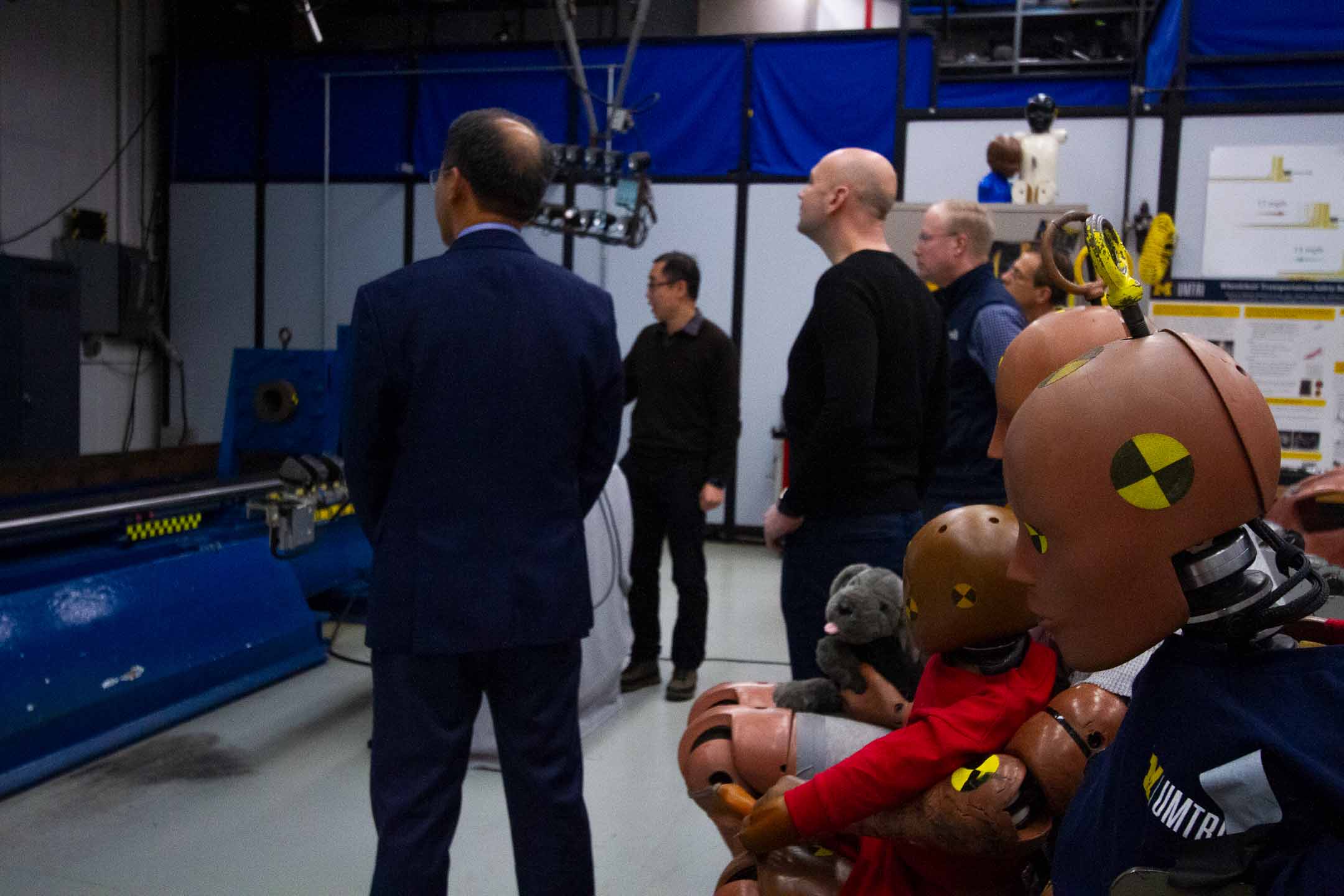
NHTSA Administration visits UMTRI
Research staff provided updates on open-source tools, projects leveraging artificial intelligence, and advanced simulation technology.
2–3 minutes

Research staff provided updates on open-source tools, projects leveraging artificial intelligence, and advanced simulation technology.
Leaders from the National Highway Traffic Safety Administration (NHTSA) visited the University of Michigan Transportation Research Institute (UMTRI) last week and saw firsthand the cutting-edge research developed and deployed in the City of Ann Arbor. Presentations showcased UMTRI’s expertise in connected vehicles and near-miss detection, crash testing, simulation, and more.
Jonathan Morrison, NHTSA administrator, and Tim Johnson, director of the NHTSA Vehicle Research and Test Center, visited UMTRI and Mcity on January 16th while they were in Michigan for the Detroit Auto Show, which brings together a full slate of major automotive brands and immersive indoor track experiences.
Debby Bezzina, senior program manager for UMTRI, discussed how AACE 2.0 uses connected vehicle and infrastructure to study vehicle interactions. This includes near-miss detection capabilities, which leverage existing and retrofitted vision systems across the city to identify and analyze safety-critical events before they occur. Haowei Sun, founder and ceo of SaferDrive AI, demonstrated TeraSim, a traffic simulation environment meticulously designed for the precise evaluation of autonomous vehicle (AV) safety performance.
The team was then led to UMTRI’s state-of-the-art impact biomechanics laboratory by Jingwen Hu, research professor at UMTRI. The lab tests the performance of safety restraints, including safety belts, child safety seats, vehicle seats, and wheelchairs. Future work will include leveraging artificial intelligence to better test edge cases in crashes, including a variety of body types. Next, the team spoke with David LeBlanc, associate research scientist at UMTRI, and Carol Flannagan, research professor at UMTRI. David and Carol discussed findings from their USDOT-funded work on the Ground Truth Trip Recorder (GTTR), which retrofits sensors and a data acquisition suite onto vehicles to observe safety-related driving performance as they operate on public roads.
Finally, Henry Liu, director of UMTRI and Mcity, drove the NHTSA representatives to the Mcity Test Facility, the world’s first purpose-built proving ground for testing the performance and safety of connected and automated vehicles. There, they experienced the Mcity AV Competency Test, a comprehensive, closed-track, and simulation-based safety assessment for Level 4 automated vehicles (AVs), designed to evaluate “roadmanship” and safety before public road deployment. Last year, Greg Stevens, research director at Mcity, argued for a road test that all AVs should pass.
“NHTSA’s visit was a great opportunity to show how the Ann Arbor Connected Environment 2.0 translates real-world data into actionable safety insights. By studying how vehicles, infrastructure, and people interact, AACE 2.0 helps inform policies and technologies that can prevent crashes before they happen.”
Debby Bezzina, Senior Program Manager, UMTRI
The visit builds on successful showcases of life-saving technology developed at the Institute, including the 2025 UMTRI Demonstration Day, which drew dozens of experts from academia and industry across the country.
This story was written by Calvin Tuttle of the Center for Connected and Automated Transportation (CCAT).